
Differential equations and linear algebra PDFs offer crucial resources for students and researchers alike, encompassing core mathematical concepts and practical applications.
These documents frequently detail ordinary and partial differential equations, alongside vector spaces, matrices, and linear transformations.
Accessing these PDFs facilitates a deeper understanding of numerical methods and problem-solving techniques within physics, astrophysics, and engineering disciplines.
What are Differential Equations?
Differential equations are mathematical equations that relate a function with its derivatives. These equations are fundamental tools for modeling phenomena exhibiting change, appearing extensively in physics, engineering, economics, and various scientific fields. They describe how quantities change over time or with respect to other variables.
Essentially, they express the relationship between a function and its rate of change. Ordinary Differential Equations (ODEs) involve functions of a single independent variable, while Partial Differential Equations (PDEs) deal with functions of multiple independent variables.
Understanding differential equations requires a solid foundation in calculus and, crucially, linear algebra, as systems of differential equations are often represented and solved using matrix methods. PDFs dedicated to this topic often provide detailed explanations, examples, and solutions to common problems, aiding in comprehension and application;
What is Linear Algebra?
Linear algebra is a branch of mathematics concerned with vector spaces, matrices, and linear transformations. It provides a framework for representing and manipulating systems of linear equations, which are ubiquitous in science and engineering. Core concepts include vectors, which represent quantities with both magnitude and direction, and operations performed on them, like addition and scalar multiplication.
Matrices serve as organized arrays of numbers, enabling efficient representation of linear transformations and systems of equations. Understanding determinants and eigenvalues is crucial for analyzing matrix properties and solving related problems.
In the context of differential equations, linear algebra provides the tools to solve systems of equations arising from discretization methods and analyze the behavior of solutions. PDFs covering both subjects often highlight this interconnectedness, demonstrating how linear algebra simplifies complex differential equation problems.
Why Study Them Together?
Differential equations and linear algebra are deeply intertwined, making their combined study essential for tackling complex problems in various fields. Many differential equations are best solved using techniques from linear algebra, particularly when dealing with systems of equations.
Linear algebra provides the tools to analyze the behavior of solutions, determine stability, and understand the underlying structure of the system. Concepts like eigenvalues and eigenvectors are fundamental in solving linear ordinary differential equations.
PDF resources often demonstrate how matrix exponential functions are used to solve linear systems, and how linear transformations aid in analyzing partial differential equations. Studying them together equips you with a powerful toolkit for modeling and solving real-world phenomena.

Core Concepts in Differential Equations
Differential equations encompass ordinary and partial forms, with first-order and second-order linear types being foundational for modeling dynamic systems.
PDFs explore solution techniques and applications across diverse scientific disciplines.
Ordinary Differential Equations (ODEs)
Ordinary Differential Equations (ODEs) represent relationships involving functions of a single independent variable and their derivatives. PDFs dedicated to ODEs frequently cover initial value problems, where specific conditions at a point define a unique solution, and boundary value problems, requiring solutions to satisfy conditions at multiple points.
These resources delve into analytical methods like separation of variables, integrating factors, and power series solutions. Numerical approaches, such as Euler’s method and Runge-Kutta methods, are also extensively detailed, providing practical tools for approximating solutions when analytical methods prove intractable.
Understanding ODEs is crucial for modeling phenomena in physics, engineering, biology, and economics. PDFs often include illustrative examples demonstrating applications in areas like population growth, circuit analysis, and mechanical oscillations, solidifying theoretical concepts with real-world relevance.
Partial Differential Equations (PDEs)
Partial Differential Equations (PDEs) extend the concepts of ODEs to functions of multiple independent variables, demanding more sophisticated analytical and numerical techniques. PDFs focusing on PDEs often begin with classifications – parabolic, hyperbolic, and elliptic – each exhibiting distinct characteristics and solution behaviors.
Common methods explored include separation of variables, Fourier transforms, and Green’s functions. Numerical solutions frequently rely on finite difference, finite element, and spectral methods, requiring substantial computational resources. These PDFs emphasize the importance of boundary and initial conditions in defining unique solutions.
PDEs are fundamental to modeling complex physical processes like heat transfer, wave propagation, and fluid dynamics. Resources often showcase applications in diverse fields, bridging theoretical understanding with practical engineering challenges and scientific investigations.
First-Order Differential Equations
First-order differential equations represent relationships involving a function and its first derivative, forming a foundational element in the study of differential equations. PDFs dedicated to this topic typically cover several solution techniques, including separation of variables, integrating factors, and exact equations.
These resources often detail linear first-order equations and Bernoulli equations, providing step-by-step guidance on finding integrating factors and transforming equations into solvable forms. Initial value problems are emphasized, demonstrating how to determine unique solutions based on specified conditions.
Applications are frequently illustrated through modeling scenarios like radioactive decay, population growth, and simple circuit analysis, showcasing the practical relevance of these mathematical tools. Understanding these concepts is crucial for progressing to more complex differential equation types.
Second-Order Linear Differential Equations
Second-order linear differential equations, a core focus in many PDFs, involve a function and its second derivative, often with applications in physics and engineering. These resources typically explore both homogeneous and non-homogeneous equations, detailing methods for finding general solutions.
The concept of linear independence and the Wronskian are frequently explained, crucial for determining the form of the general solution. PDFs often cover constant coefficient equations, utilizing characteristic equations to find solutions involving exponential functions, sine, and cosine.
Methods like variation of parameters and undetermined coefficients are presented for solving non-homogeneous equations. Real-world applications, such as modeling damped harmonic oscillators and spring-mass systems, are commonly illustrated, solidifying understanding.

Fundamental Concepts in Linear Algebra
Linear algebra PDFs cover vectors, matrices, determinants, and transformations, providing essential tools for solving systems of equations and analyzing data effectively.
Vectors and Vector Spaces
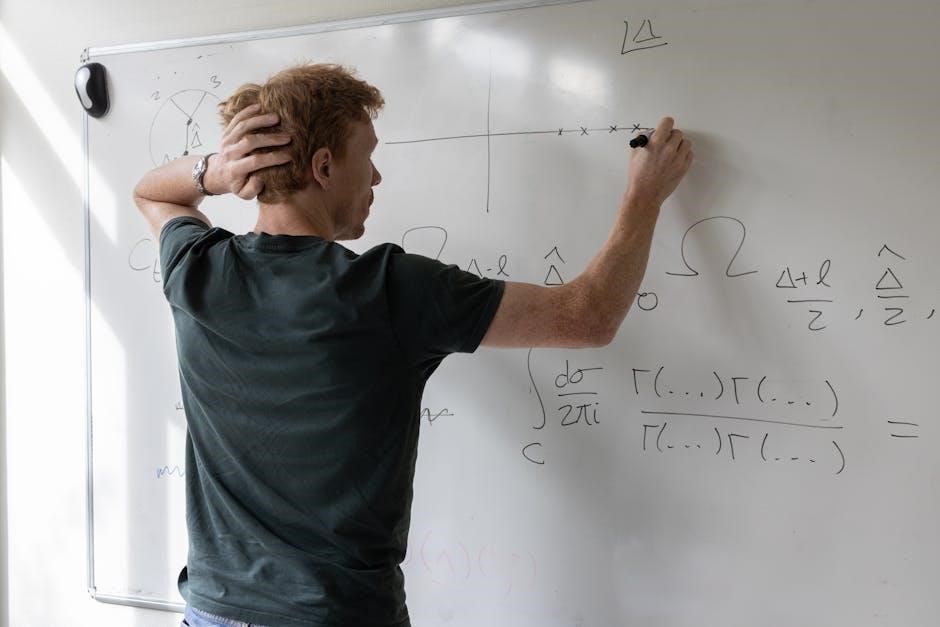
Vectors, fundamental building blocks in linear algebra, are often presented in PDFs as ordered lists of numbers, representing magnitude and direction. These PDFs detail operations like vector addition, scalar multiplication, and the calculation of dot and cross products.
Crucially, they introduce the concept of vector spaces – sets of vectors satisfying specific axioms, enabling generalization beyond simple geometric interpretations. Understanding vector spaces is vital when applying linear algebra to solve differential equations, particularly when dealing with solution spaces.
PDF resources often illustrate linear independence, basis, and dimension, concepts essential for representing solutions and analyzing the properties of linear systems. These materials frequently demonstrate how vectors can represent functions, a key connection to the study of differential equations and their solutions.
Matrices and Matrix Operations
Matrices, rectangular arrays of numbers, are central to both linear algebra and solving differential equations, as detailed in numerous PDFs. These resources thoroughly cover fundamental matrix operations: addition, subtraction, multiplication, and scalar multiplication.
PDFs emphasize the importance of matrix inverses and their role in solving systems of linear equations, frequently encountered when analyzing linear differential equations. They also explain matrix transposition and trace calculations.
Advanced PDFs delve into special matrix types – symmetric, Hermitian, and orthogonal – and their properties. Understanding these operations is crucial for representing linear transformations and simplifying complex calculations, ultimately aiding in the efficient solution of mathematical models described by differential equations.
Determinants and Their Properties
Determinants, scalar values computed from square matrices, are a cornerstone of linear algebra, extensively covered in available PDF resources. These documents detail how determinants indicate whether a matrix is invertible – a critical property for solving systems of equations arising in differential equations.
PDFs explain the properties of determinants, including how row operations affect their values and how they relate to matrix rank. Understanding these properties is vital for efficiently solving linear systems and analyzing the stability of solutions to differential equations.
Furthermore, resources highlight the connection between determinants and eigenvalues, essential for diagonalizing matrices and simplifying the analysis of linear transformations, frequently used in advanced mathematical modeling.
Linear Transformations
Linear transformations, central to linear algebra, are thoroughly explored in numerous PDF resources, often within the context of solving differential equations. These transformations map vectors from one space to another while preserving vector addition and scalar multiplication.
PDF materials demonstrate how matrices represent linear transformations, enabling efficient computation and analysis. Understanding these transformations is crucial for analyzing the behavior of systems described by linear equations, frequently encountered in physics and engineering applications.
Resources detail concepts like kernel, range, and invertibility of linear transformations, providing tools for understanding solution spaces and stability. They also illustrate how linear transformations simplify complex problems, offering a powerful approach to mathematical modeling.

The Interplay Between Differential Equations and Linear Algebra
Linear algebra provides essential tools for solving differential equations, particularly through systems of equations, eigenvalues, and matrix exponentials, as detailed in PDF resources.
Systems of Linear Equations and ODEs
Systems of linear equations frequently arise when tackling ordinary differential equations (ODEs). Many ODEs, especially those modeling interconnected phenomena, can be elegantly reformulated as matrix equations. This transformation allows us to leverage the powerful techniques of linear algebra for analysis and solution.
PDF resources often demonstrate how initial value problems for ODEs translate into systems of linear equations, enabling the application of methods like Gaussian elimination or matrix inversion. Furthermore, understanding the properties of matrices – such as determinants and eigenvalues – provides insights into the stability and behavior of solutions. The interplay is crucial; solving the system yields the functions that satisfy the original differential equation.
These PDF materials frequently showcase examples from physics and engineering, illustrating how this connection simplifies complex modeling and analysis. The ability to convert an ODE into a linear system is a cornerstone of applied mathematics.
Eigenvalues and Eigenvectors in Solving ODEs
Eigenvalues and eigenvectors play a pivotal role in solving systems of linear ordinary differential equations, as detailed in many PDF resources. When a matrix representing the system can be diagonalized, the problem simplifies dramatically. The eigenvectors form a basis for the solution space, and the eigenvalues dictate the exponential behavior of each component.

PDF materials often illustrate how finding these values allows decoupling of the system into independent, first-order ODEs, each easily solvable. This technique is particularly effective for constant-coefficient linear systems. Understanding the nature of eigenvalues (real, complex, repeated) reveals crucial information about solution stability and oscillatory behavior.
Consequently, mastering this connection between linear algebra and differential equations is essential for anyone studying dynamic systems, as highlighted in numerous academic PDF documents.
Matrix Exponential and Linear Systems
The matrix exponential, eAt, provides a powerful and elegant method for solving linear systems of ordinary differential equations, extensively covered in PDF resources. This approach offers a compact and general solution, particularly useful when dealing with time-varying systems.
PDF materials demonstrate how the matrix exponential encapsulates the combined effect of repeated matrix multiplications over time. Calculating this exponential often involves eigenvalue decomposition or series expansions. Understanding its properties is crucial for analyzing system stability and transient responses.

Furthermore, many linear algebra focused PDF guides explain how the matrix exponential connects directly to the fundamental matrix solution, providing a comprehensive framework for analyzing and solving these types of systems.
Using Linear Algebra to Analyze PDE Solutions
Partial differential equations (PDEs) often benefit from techniques rooted in linear algebra, as detailed in numerous PDF resources. Methods like spectral analysis and finite element methods heavily rely on representing PDE solutions as linear combinations of basis functions.
PDF guides illustrate how eigenvalue problems arising from the PDE can be solved using matrix representations, allowing for the decomposition of complex solutions into simpler, manageable components. This approach is particularly effective for analyzing boundary value problems.
Furthermore, linear algebra provides tools to assess the stability and convergence of numerical schemes used to approximate PDE solutions, ensuring the accuracy and reliability of the results. These PDF materials often include practical examples and applications.

Resources: Finding Relevant PDFs
Online repositories, university websites, and open educational resources (OER) provide accessible PDF documents for differential equations and linear algebra studies.
Textbook solutions are also available.
Online Repositories for Lecture Notes
Numerous online platforms serve as valuable repositories for lecture notes, course materials, and solved problems related to differential equations and linear algebra, often available in PDF format. MIT OpenCourseWare is a prominent example, offering a wealth of resources from introductory to advanced courses, including complete lecture notes and assignments.
Khan Academy provides comprehensive video tutorials and accompanying practice exercises, though direct PDF downloads of lecture notes are less common; however, transcripts can be saved. Course Hero and StuDocu host user-uploaded materials, encompassing lecture notes, past exams, and study guides, but quality and accuracy can vary, requiring careful evaluation.
Internet Archive contains digitized textbooks and course materials, potentially including relevant PDFs. Searching specific university course codes alongside “lecture notes” or “course materials” can also yield results. Remember to always verify the source and accuracy of information obtained from these repositories.
University Course Websites
Directly exploring university course websites often yields high-quality PDF resources for differential equations and linear algebra. Many professors post lecture notes, homework assignments, solutions, and even full course syllabi online. Institutions like Stanford, Harvard, and Caltech frequently make course materials publicly accessible, though navigation can sometimes be challenging.
Searching for specific course codes (e.g., “MATH 2210”) along with keywords like “lecture notes” or “syllabus” can pinpoint relevant pages. Look for sections labeled “Course Materials,” “Resources,” or “Assignments.” APPM 1360 at the University of Colorado Boulder is an example of a course with publicly available information.
Repositories like GitHub sometimes host course materials shared by students or instructors. Always check the copyright and usage permissions before downloading or distributing any content found on these websites.
Textbook Solutions Manuals (PDFs)
Textbook solutions manuals in PDF format are invaluable resources for students tackling differential equations and linear algebra problems. These manuals provide step-by-step solutions to exercises, aiding in understanding complex concepts and verifying problem-solving approaches. However, access can be tricky, often requiring purchase or institutional access.
Online searches using the textbook title, edition, and “solutions manual PDF” can sometimes uncover free or low-cost options, but caution is advised regarding copyright infringement. Beware of unreliable websites offering downloads – prioritize legitimate sources.
University libraries often provide access to digital solutions manuals through their online databases. Utilizing these resources ensures legal and reliable access to essential study aids.
Open Educational Resources (OER) PDFs
Open Educational Resources (OER) PDFs represent a fantastic, freely accessible avenue for studying differential equations and linear algebra. These resources, often created by universities and educators, offer comprehensive textbooks, lecture notes, and problem sets under open licenses.
MIT OpenCourseWare and similar platforms are excellent starting points, providing complete course materials in PDF format. These materials frequently include problem sets with solutions, fostering independent learning. OER Commons is another valuable repository, aggregating resources from various institutions.
The quality of OER materials can vary, so it’s crucial to evaluate the author’s credentials and the resource’s comprehensiveness before relying on it. However, they offer a cost-effective and flexible learning option.

Software Tools for Solving and Visualizing
MATLAB, Python (with NumPy and SciPy), and Mathematica are powerful tools for solving and visualizing problems in differential equations and linear algebra.
MATLAB for Differential Equations and Linear Algebra
MATLAB stands as a premier computational environment extensively utilized for solving both differential equations and performing linear algebra operations. Its robust functionality includes dedicated toolboxes for symbolic computation, numerical analysis, and visualization, making it ideal for tackling complex mathematical problems.
Specifically, MATLAB’s ode45 function provides a versatile solver for ordinary differential equations (ODEs), while its linear algebra capabilities encompass matrix decomposition, eigenvalue calculations, and solving systems of linear equations efficiently. Users can leverage MATLAB’s plotting features to visualize solutions, analyze stability, and gain deeper insights into the behavior of dynamic systems.
Furthermore, the availability of numerous online resources, tutorials, and example scripts simplifies the learning curve for students and researchers. PDF documentation and community forums offer support for implementing and troubleshooting MATLAB-based solutions for a wide range of applications in engineering, physics, and applied mathematics.
Python with NumPy and SciPy
Python, coupled with the powerful libraries NumPy and SciPy, presents a compelling alternative to MATLAB for tackling differential equations and linear algebra problems. NumPy provides efficient array operations, crucial for representing matrices and vectors, while SciPy offers specialized modules for numerical integration, optimization, and linear algebra.
SciPy’s odeint and solve_ivp functions enable the solution of ordinary differential equations (ODEs), offering flexibility in choosing integration methods. Linear algebra routines within SciPy facilitate matrix decomposition, eigenvalue analysis, and solving systems of equations. Python’s clear syntax and extensive visualization libraries, like Matplotlib, enhance interpretability.
Numerous PDF tutorials and online resources demonstrate Python’s capabilities in these areas, making it accessible for both beginners and experienced programmers. The open-source nature of Python and its libraries fosters a vibrant community and continuous development of new tools.
Mathematica
Mathematica stands as a robust computational environment widely utilized for solving complex differential equations and performing advanced linear algebra operations. Its symbolic computation capabilities allow for analytical solutions to many ODEs and PDEs, a feature often exceeding the reach of numerical methods alone. The software excels in matrix manipulation, determinant calculations, and eigenvalue/eigenvector analysis.

Numerous PDF guides and documentation resources detail Mathematica’s functions for solving differential equations, including DSolve and its variants. Its interactive notebook interface facilitates experimentation and visualization of results. Mathematica’s strength lies in its ability to seamlessly integrate symbolic and numerical approaches.
While requiring a commercial license, Mathematica provides a comprehensive toolkit for mathematical modeling and analysis, making it a valuable asset for researchers and students alike.